
1. The Traffic Era Is Changing
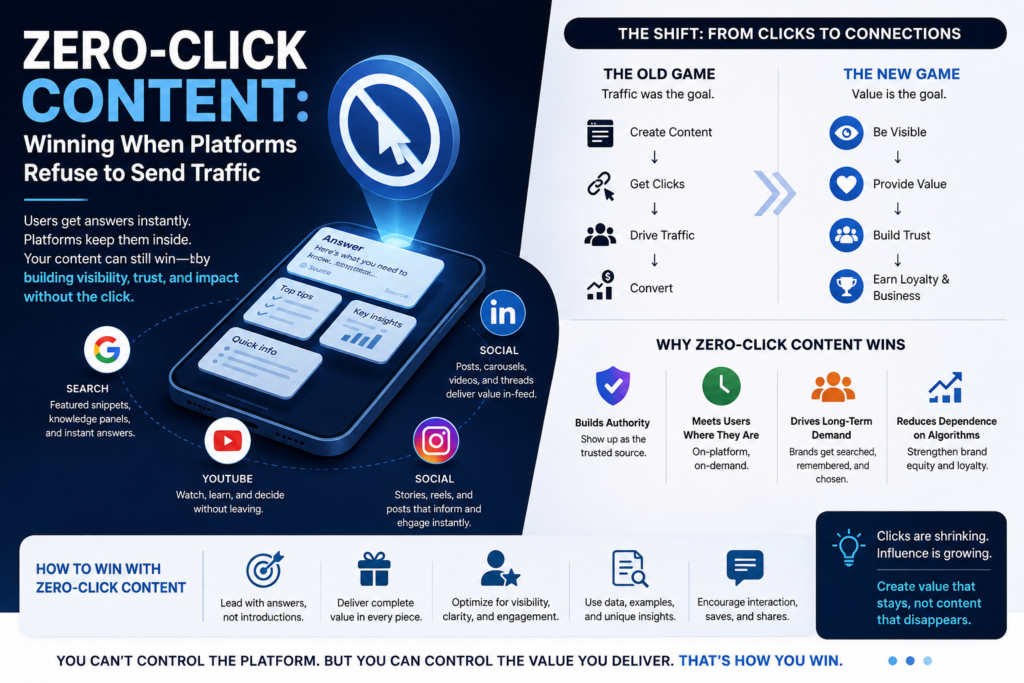
For years, digital marketers treated website traffic as one of the most important indicators of online success. The traditional strategy was straightforward: create valuable content, optimize it for search engines, attract visitors, and convert those visitors into customers. However, the digital environment has changed significantly. Search engines, social platforms, AI-powered interfaces, and content aggregators increasingly provide users with answers directly on their platforms.
As a result, users do not always need to click through to a publisher’s website. This behavior has created the concept of Zero-Click Content, where users consume the information they need without leaving the platform. Although this development may initially appear threatening to marketers, it also creates a new opportunity. Instead of measuring success only through website visits, brands can focus on visibility, authority, engagement, recognition, and conversions that happen directly within the platform.
2. What Is Zero-Click Content?
Zero-Click Content refers to content that provides enough value directly within the platform that users do not need to click another link to obtain the information. Search engines may display an answer in a featured snippet, while social media platforms may present an entire educational post directly in the user’s feed.
For example, a brand might publish a LinkedIn post explaining five ways to improve a marketing campaign. Instead of forcing readers to visit a website for the complete answer, the company provides the information directly. Similarly, a search engine may display an answer to a user’s question without requiring the user to open a webpage. Therefore, the content achieves its primary informational objective even without generating a click.
3. Why Platforms Keep Users Inside Their Ecosystems
Platforms have strong incentives to keep users within their own environments. Search engines want users to find answers quickly, while social networks want users to continue scrolling, watching, commenting, and interacting. Consequently, platforms increasingly prioritize content formats that satisfy user intent without requiring an external visit.
This shift creates a challenge for businesses that traditionally depend on referral traffic. However, it also encourages marketers to reconsider what they want content to achieve. A post does not necessarily fail simply because it generates fewer website visits. If it increases brand recognition, establishes expertise, earns engagement, or encourages future purchases, it can still produce meaningful business value.
Therefore, marketers should stop treating the click as the only definition of success. Instead, they should build content strategies that deliver value wherever the audience discovers the brand.
4. From Clicks to Visibility: A New Definition of Success
Digital marketing metrics have traditionally emphasized sessions, page views, bounce rates, and referral traffic. These metrics remain useful, but they do not capture the entire impact of zero-click experiences. A user may discover a brand through a social media post, remember its name, and eventually search for the company directly weeks later.
Consequently, marketers need to consider metrics such as impressions, branded searches, engagement, saves, shares, mentions, comments, profile visits, and direct traffic. These indicators can reveal whether content is influencing audience behavior even when the initial interaction produces no website visit.
Moreover, brand visibility can become a valuable objective in a zero-click environment. When users repeatedly encounter helpful and authoritative content from the same company, they begin to associate that company with expertise. Over time, this familiarity can influence purchasing decisions.
5. Creating Content That Completes the Journey
One of the most effective approaches to Zero-Click Content involves creating content that provides a complete answer within the platform. Instead of writing a short introduction and forcing users to click a link, marketers should deliver the core insight immediately.
For example, an SEO professional could create a post explaining how to identify search intent. The post could define search intent, explain the major categories, and provide practical examples. The reader receives genuine value without visiting another webpage. However, the brand can still include a subtle call to action, such as inviting users to follow the account or explore additional resources.
This strategy creates a relationship based on value rather than interruption. Furthermore, users are more likely to engage with content when they know that the brand consistently provides useful information without demanding a click in return.
6. Search Engines and the Rise of Zero-Click Searches
Zero-click searches have become an important part of modern search behavior. Search engines increasingly provide direct answers through featured snippets, knowledge panels, local results, calculators, definitions, and other search features.
Therefore, traditional SEO strategies must evolve. Ranking in the first position remains valuable, but marketers should also consider how their content appears within search features. The objective should not simply be to attract a click. Instead, businesses should aim to become the source that search engines recognize as useful, accurate, and authoritative.
This requires clear content structures, concise answers, strong topical relevance, credible information, and effective optimization. When a brand earns visibility directly within search results, it can strengthen its authority even when the user does not visit the website.
7. Social Media Is Becoming the Destination
Social media platforms once functioned primarily as channels for distributing links. Marketers would publish a short post and encourage followers to click through to an external article. Today, however, platforms increasingly reward native content that keeps users engaged within their ecosystems.
As a result, marketers should adapt their approach. Instead of publishing only promotional links, businesses can create native educational posts, carousels, videos, tutorials, checklists, polls, and thought-leadership content. These formats can communicate substantial value without requiring an external visit.
Furthermore, native content can encourage stronger interaction. Users can comment, share, save, or discuss the content directly on the platform. Consequently, a brand can build a community around its expertise rather than relying entirely on website traffic.
8. The Art of Giving Away the Answer
A common concern among marketers involves giving away too much information. They may believe that if they provide the complete answer, users will have no reason to visit their website. However, this assumption can limit content quality.
In reality, freely sharing valuable knowledge can strengthen trust and authority. A potential customer who receives a useful solution from a brand may become more likely to consider that brand when they need a product or service. Therefore, Zero-Click Content can function as a trust-building mechanism.
The key lies in separating information from deeper value. A social post might explain how to solve a common problem, while a company’s paid service provides implementation, customization, support, or advanced expertise. In this model, content demonstrates competence, while the business provides the complete commercial solution.
9. Designing Content for Every Platform
A successful zero-click strategy requires marketers to understand that every platform has its own audience behavior and content preferences. A detailed LinkedIn article may work well for professional audiences, while a short Instagram carousel may communicate the same concept more effectively to visual learners.
Therefore, marketers should avoid copying identical content across every channel. Instead, they should adapt the message to the environment. A long-form article can become a series of short social posts, a video script, an infographic, or a concise checklist.
Moreover, platform-specific optimization can improve content performance. Marketers should consider the platform’s preferred formats, audience expectations, content length, visual style, and interaction patterns. By doing so, they can make each piece of content feel native rather than repurposed.
10. Building Authority Without Depending on Clicks
Authority has become increasingly important in a digital environment where audiences encounter information from countless sources. Users need reasons to trust a brand, and consistent high-quality content can provide those reasons.
Zero-click strategies allow brands to demonstrate expertise repeatedly. A company that consistently answers difficult questions, explains industry developments, shares practical insights, and corrects common misconceptions can become a recognizable authority within its niche.
Additionally, repeated exposure can strengthen brand recall. Even if users never click a website link during their first interaction, they may remember the company later. Consequently, zero-click content can contribute to the broader customer journey rather than serving as an isolated traffic-generation tactic.
11. Measuring What Happens After the Click Disappears
When clicks become less important, marketers need to develop a broader measurement framework. Website traffic should remain part of the analysis, but businesses should also track indicators that reflect attention and influence.
Engagement rate, shares, saves, comments, mentions, branded search volume, follower growth, direct traffic, lead quality, and conversion rates can provide valuable insights. Furthermore, marketers can compare content exposure with changes in branded demand over time.
For example, a campaign might generate fewer website visits than expected but produce a significant increase in branded searches and qualified inquiries. If marketers evaluate only referral traffic, they may incorrectly classify the campaign as unsuccessful. Therefore, measurement must reflect the entire customer journey rather than one isolated interaction.
12. Zero-Click Content and the Future of Digital Marketing
The growth of AI-powered search, social media ecosystems, and direct-answer interfaces will likely make zero-click experiences increasingly common. Users will continue to expect immediate answers, concise explanations, and useful information without unnecessary friction.
As a result, brands must become comfortable with the idea that valuable content does not always need to generate a click. Instead, content can create awareness, demonstrate expertise, influence perception, and establish trust directly within the platform.
Ultimately, Zero-Click Content does not represent the death of digital marketing. It represents an evolution in how marketers define value. The strongest brands will not fight every platform’s desire to retain users. Instead, they will create content that succeeds within those environments while building a recognizable identity that audiences carry with them beyond the platform.
13. Winning the Zero-Click Future
The future belongs to brands that understand the difference between traffic and influence. A website visit is valuable, but it represents only one form of audience interaction. A saved post, shared insight, memorable video, featured search result, or useful answer can also influence a customer’s decision.
Therefore, businesses should build content strategies around three principles: provide immediate value, build lasting authority, and measure meaningful outcomes. When marketers follow these principles, they can turn platform limitations into strategic opportunities.
The central lesson is simple: do not create content merely to make people click; create content that makes people remember, trust, and choose your brand. In a digital landscape where platforms increasingly keep audiences inside their ecosystems, Zero-Click Content gives businesses a way to remain visible, useful, and influential—even when the traffic never arrives.