
1. The Hidden Cost of Too Much Content
In today’s digital marketing landscape, businesses often assume that publishing more content automatically leads to greater visibility. As a result, companies continuously create blog posts, landing pages, product descriptions, guides, news updates, and promotional content. However, this constant flow of publishing can eventually create a hidden problem. Websites may accumulate outdated, duplicated, irrelevant, or underperforming pages that provide little value to users while potentially weakening overall search performance.
This growing collection of unnecessary content can create what is commonly referred to as digital clutter. Just as physical clutter can make a workspace difficult to navigate, digital clutter can make a website harder to manage, understand, and optimize. Therefore, businesses should regularly conduct an SEO Content Audit to evaluate existing pages, identify content that no longer serves a clear purpose, and determine what should be updated, consolidated, or removed. Ultimately, effective SEO is not always about creating more content; sometimes, removing low-value content is the smarter strategy for improving search rankings, enhancing user experience, and strengthening brand trust.
2. What Is a Digital Clutter Audit?
A Digital Clutter Audit is a systematic review of a website’s content to determine which pages should remain, improve, consolidate, redirect, or disappear. The process examines factors such as traffic, search visibility, backlinks, conversions, relevance, accuracy, engagement, and overall usefulness. Rather than measuring success simply by the number of published pages, marketers evaluate whether each piece of content continues to serve a meaningful purpose.
Furthermore, a Digital Clutter Audit should consider both SEO performance and brand value. A page might generate a small amount of traffic but still provide important information to customers. Conversely, another page might attract visitors while presenting outdated information that damages the company’s credibility. Therefore, marketers should combine quantitative data with qualitative judgment before deciding whether to delete content.
3. Why Deleting Content Can Strengthen SEO
Many marketers hesitate to delete webpages because they assume every page contributes something to organic visibility. However, maintaining large amounts of weak content can make website management more difficult and create a confusing experience for users. Search engines increasingly aim to provide useful, relevant, and trustworthy results. Therefore, businesses should focus on maintaining a strong collection of valuable pages rather than simply increasing page volume.
Content pruning provides a strategic way to achieve this goal. By identifying pages that have little value, businesses can remove or consolidate them and create a more focused website. Consequently, search engines and users can encounter a clearer topical structure. Although deleting content does not automatically increase rankings, reducing unnecessary pages can help organizations concentrate their optimization efforts on content that genuinely deserves visibility.
4. The Difference Between Old Content and Bad Content
Not every old webpage represents digital clutter. Some older articles continue to generate organic traffic, attract backlinks, answer important questions, or establish authority. Therefore, marketers should never delete content simply because it has an old publication date.
Instead, businesses should evaluate whether the content remains accurate, relevant, useful, and aligned with current search intent. An article published several years ago may still provide exceptional value, while a recently published article may already be obsolete. Consequently, the age of a page should act as a signal for review rather than an automatic reason for removal.
5. The SEO Signals That Tell You What to Remove
A successful content audit relies on evidence. Marketers should examine organic traffic, keyword rankings, impressions, clicks, backlinks, conversions, engagement, and internal links. Pages that consistently demonstrate little or no value deserve closer investigation.
However, numbers alone should not determine the final decision. A page with low traffic might support an important customer journey or target a highly specific but commercially valuable search query. Therefore, marketers should assess each page within the context of the broader website.
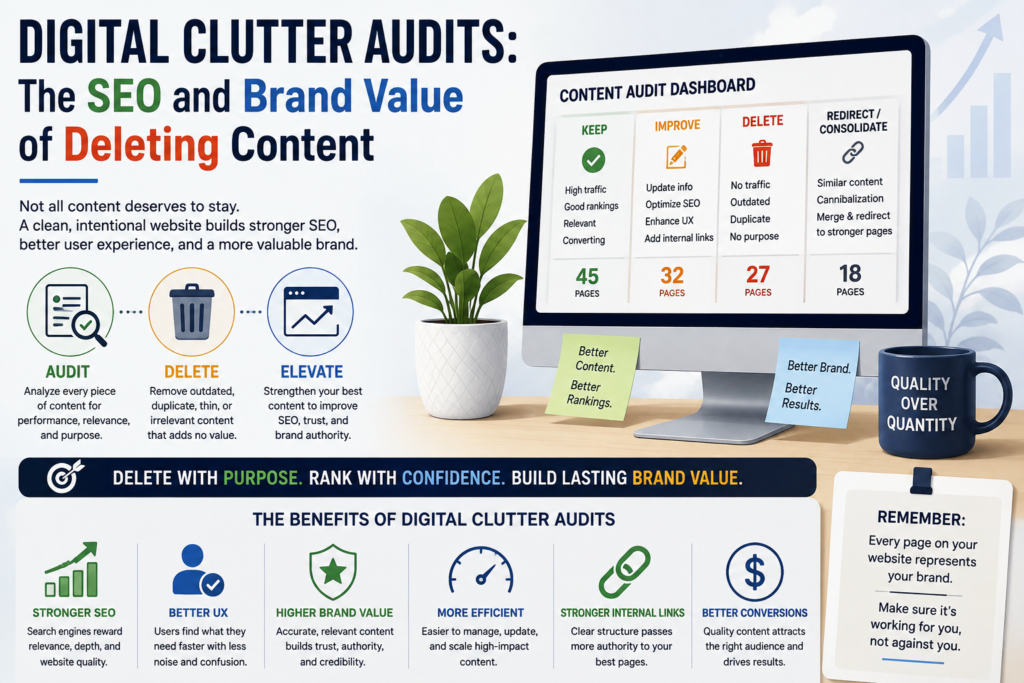
A useful content evaluation can place pages into several categories:
- Keep: Valuable, relevant, and performing content.
- Improve: Useful content that requires updates.
- Consolidate: Similar pages that can become one stronger resource.
- Redirect: Outdated pages with useful links or a relevant replacement.
- Delete: Content that provides little strategic, user, or SEO value.
This structured approach makes deleting content a strategic decision rather than an impulsive cleanup exercise.
6. Content Cannibalization: When Your Own Pages Compete
One of the less obvious problems created by excessive content is keyword cannibalization. This occurs when multiple pages target similar search queries or address nearly identical topics. Instead of creating a stronger topical resource, the website distributes relevance across several competing pages.
Consequently, marketers may find that several pages fluctuate in search results without establishing a clear authority for the topic. A Digital Clutter Audit can identify these overlaps and reveal opportunities to consolidate related pages into one comprehensive resource.
Moreover, consolidation can improve the user experience. Rather than forcing visitors to navigate several similar articles, businesses can provide one authoritative page that answers the user’s questions more completely. In this way, content pruning can support both SEO and usability.
7. Protecting Brand Value by Removing Outdated Information
SEO represents only one reason to conduct a Digital Clutter Audit. Brand reputation provides another equally important reason. Visitors often judge a business based on the information they encounter on its website. Outdated statistics, discontinued products, incorrect pricing, expired offers, old company information, or inaccurate advice can make a brand appear careless.
Therefore, deleting outdated content can protect brand value. When visitors consistently find accurate and relevant information, they are more likely to perceive the organization as professional and trustworthy. In contrast, a website filled with obsolete pages can weaken confidence even if those pages still attract occasional visitors.
Furthermore, content should reflect the current positioning of the business. Companies evolve over time, and their websites should evolve with them. A more cohesive brand identity can be achieved by eliminating content that no longer accurately reflects the company’s knowledge, offerings, principles, or target market.
8. Better User Experience Through Less Content
A successful website does not need to overwhelm visitors with information. Instead, it should help users find the right information quickly. Excessive pages can create navigation problems, duplicate information, inconsistent messaging, and unnecessary decision-making.
Consequently, digital decluttering can improve user experience. When businesses remove repetitive and irrelevant pages, they can create clearer navigation paths and stronger internal linking structures. Visitors can then move from informational content to relevant products, services, or contact pages with less friction.
Additionally, a cleaner website can make content management easier for internal teams. Writers, designers, developers, and marketers can identify important pages more easily when the website does not contain hundreds of forgotten URLs. Therefore, digital organization benefits both the audience and the organization behind the website.
9. The Art of Consolidating Instead of Simply Deleting
Deleting content is not always the best solution. Sometimes several weak pages contain valuable information that can become significantly stronger when combined. This is where content consolidation becomes especially useful.
For example, a website might contain five separate articles covering closely related aspects of the same subject. Instead of maintaining all five pages, marketers can combine the strongest information into one comprehensive resource. The original pages can then be redirected to the new destination when appropriate. As a result, the business creates a stronger content asset while reducing unnecessary duplication.
This strategy can also improve internal linking and content authority. One well-structured resource may provide a clearer answer than several fragmented articles. Therefore, marketers should always ask an important question before deleting a page: Can the useful information be transformed into something better?
10. How to Conduct a Digital Clutter Audit
The first step involves creating a complete inventory of website content. Marketers should identify URLs and collect relevant performance information. Useful data can include organic traffic, impressions, clicks, ranking keywords, backlinks, conversions, publication dates, and content categories.
Next, marketers should evaluate each page according to its strategic purpose. They should ask whether the page attracts the right audience, supports a business objective, answers a relevant question, represents the brand accurately, and provides unique value. Pages that fail several of these tests should receive additional attention.
Afterward, marketers can assign each URL an action: keep, update, consolidate, redirect, or delete. Importantly, teams should document these decisions. This creates a clear record of the audit and prevents valuable information from being removed accidentally.
11. Deleting Content Without Creating SEO Problems
Although content pruning can provide significant benefits, careless deletion can also create problems. Removing pages that have valuable backlinks, strong rankings, or meaningful referral traffic can result in lost value. Therefore, marketers should investigate a URL’s historical and current performance before permanently deleting it.
When a page has valuable links or an appropriate replacement exists, a relevant redirect may be preferable. However, marketers should avoid redirecting every deleted URL to an unrelated page simply to preserve technical signals. The replacement should genuinely satisfy the user’s intent.
Similarly, businesses should update internal links after removing pages. Broken links can frustrate users and make website maintenance more difficult. Therefore, a successful content deletion process should include redirects, internal-link reviews, sitemap updates, and performance monitoring where appropriate.
12. The Brand Strategy Behind a Cleaner Website
A website functions as more than an SEO asset. It also acts as a digital representation of a company’s expertise and identity. Consequently, every published page can influence how audiences perceive the brand.
Digital Clutter Audits allow organizations to bring their websites closer to their current strategic direction. Businesses can remove outdated campaigns, duplicate explanations, weak articles, and irrelevant pages while highlighting their strongest resources. As a result, the website can communicate a clearer and more confident message.
Moreover, a smaller collection of high-quality resources can make content marketing more sustainable. Teams can focus their resources on updating important pages instead of continuously producing new material simply to maintain a large publishing schedule.
13. Why “Less” Can Become a Powerful SEO Strategy
The modern SEO environment rewards strategic thinking rather than content volume alone. Publishing more pages does not automatically create more authority. Instead, organizations should aim to build a website where every important page has a clear purpose.
Therefore, deleting content can become a competitive strategy when marketers use data and judgment to guide the process. Removing weak pages can help teams focus on improving the resources that matter most. Similarly, consolidating overlapping content can create stronger and more comprehensive resources.
However, businesses should avoid treating content pruning as a one-time project. Websites constantly change as products evolve, markets shift, search behavior develops, and information becomes outdated. Consequently, organizations should incorporate regular content audits into their long-term content strategy.
14. Turning Digital Decluttering Into Long-Term Growth
A successful Digital Clutter Audit does more than reduce the number of URLs on a website. It creates an opportunity to rethink the relationship between content, SEO, users, and brand strategy. By identifying what deserves attention and removing what no longer contributes value, businesses can create a more focused digital presence.
Furthermore, the process encourages marketers to think critically about why each page exists. Instead of asking, “How much content can we publish?” organizations can ask, “What information genuinely helps our audience and strengthens our brand?” This shift can lead to more meaningful content creation and better resource allocation.
Ultimately, the value of Digital Clutter Audits lies in their ability to transform a website from a collection of accumulated pages into a purposeful digital ecosystem. When businesses combine careful analysis, strategic content pruning, thoughtful consolidation, and responsible deleting content, they can improve website quality while protecting long-term SEO and brand value.
15. The Future of SEO May Be Cleaner, Not Bigger
Digital marketing has spent years encouraging businesses to create more. More articles, more landing pages, more keywords, and more campaigns often became the default answer to declining visibility. However, the future requires a more sophisticated approach. Quality, relevance, usefulness, and trust increasingly matter more than content volume alone.
Consequently, Digital Clutter Audits deserve a permanent place in modern SEO and brand management. A well-maintained website can communicate expertise more effectively, provide a smoother user experience, and help audiences discover the information that matters most.
The central lesson is simple: not every piece of content deserves to stay online forever. Sometimes the most valuable SEO action is to improve an existing page. Sometimes it is to combine several pages into one stronger resource. And sometimes, the smartest decision is to delete content entirely.
By embracing strategic content pruning, organizations can create websites that are smaller in volume but stronger in purpose. In the long term, that clarity can support better search visibility, stronger brand value, improved user experience, and a more effective digital marketing strategy.